
In this article
Need a little support with this?
Rachel’s work is shame-free, direct, and grounded in therapy-informed tools for sex, relationships, and mental health.
Shame-free note: Use this article as a starting point, not a scorecard. Take what helps, leave what does not, and come back to the parts that deserve more care.
“How do I tell my parents I’m polyamorous?” is one of the questions I hear most often from non-monogamous clients, and it’s usually followed by, “Do I even need to?”
Coming out as polyamorous or non-monogamous to friends and family is complicated in a way that’s hard to prepare for, because it goes beyond sharing information. You’re letting people into a part of your life that challenges assumptions they may have never questioned — assumptions about love, commitment, morality, and what a “real” relationship looks like.
Some people in your life will get it, some won’t, and some will surprise you in both directions.
When I first came out as polyamorous / non-monogamous, I was so excited and so nervous. I was already living this life that felt in such alignment with who I was and I wanted to shout that from the rooftops, but I was so scared for criticism, or someone ‘raining on my parade.’ It felt very empowering to tell family and friends and then validating when many of them were not surprised at all. Of course, most had questions and some concerns, but I was met with a lot of love. The most criticism or judgement I received came from coming out as poly online. It was wild to me that strangers on the internet had more to say about my life and who I am than the people who have known me the longest and knew/know me best.
Here’s how you can think about the process, what the research says about how it tends to go, and how to take care of yourself through it.
Why This Conversation Feels So Loaded
Coming out as polyamorous or non-monogamous isn’t the same as announcing you got a new job. It touches on identity, values, sexuality, and social norms all at once, which is why it can feel so high-stakes even when logically you know the people you’re telling love you.
There’s a reason for that weight. Research repeatedly shows that people in non-monogamous relationships face real stigma. A study by Moors, Matsick, and Schechinger found that individuals in non-monogamous relationships were viewed more negatively than those in monogamous ones across a range of qualities, both relationship-specific and otherwise (Moors et al., 2017). And this wasn’t a subtle bias; it was a measurable, consistent pattern.
A 2024 survey by OPEN (Organization for Polyamory and Ethical Non-Monogamy) found that 60% of non-monogamous respondents had experienced stigma or discrimination in at least one area of their lives. And that stigma often intensifies around family — especially when children are involved.
So if you’re anxious about this conversation, that makes sense… you’re reading our mononormative social landscape.
What the Research Says About Disclosure
A 2025 study by Tarantino, published in the Journal of Marriage and Family, is one of the first to directly examine how polyamorous people disclose their identity to their parents. The researchers interviewed 28 non-monogamous individuals about their disclosure experiences and identified several patterns worth noting (Tarantino, 2025).
How People Disclosed
Some used planned, deliberate approaches like sitting parents down for a conversation or writing a letter. Others disclosed more organically, when a situation made it natural (like introducing a partner). There was/is no single “right” way, but people who had thought through their approach tended to feel more prepared for whatever followed next.
Parental Reactions
Reactions ranged widely. Some parents were accepting, curious, or neutral. Others were confused, worried, or openly disapproving. A common early reaction was concern — not necessarily rejection, but anxiety about whether their child was safe, happy, or making a mistake.
Why Some People Don’t Disclose
The study also found that many non-monogamous individuals choose not to tell their parents at all, often because of anticipated negative reactions, concern about damaging the relationship, or a sense that it simply wasn’t their parents’ business. Concealing their identity entailed its own costs, though, including feeling fragmented, having to hide partners, and managing the stress of constant self-monitoring.
The Bigger Picture
A 2023 study published in Sexuality & Culture looked at stigma and resiliency in non-monogamous relationships, finding that the experience of stigma and fear of moral judgment forced many individuals to conceal or minimize their non-monogamous lives and/or identity. The folks who chose to conceal had worse mental health outcomes than those who didn’t. However, the folks who decided to share were often faced with stigma thrown right at them. (Stigma and Resilience in Non-Monogamous Relationships, 2023).
This study shows that disclosure is a real decision with real consequences, and there’s no single right answer. What matters is that you make the choice that works for your life, with your eyes open.
Before You Tell Anyone: Things to Think About First
Before you start having these conversations, it’s worth spending some time with yourself first.
Get clear on why you want to tell them
Are you telling them because you want to share your full life? Because you’re tired of hiding a partner? You want support? Because it feels dishonest not to? All of these are valid reasons, but knowing your “why” helps you set the right expectations for the conversation.
Think about what you want from the conversation
Do you want acceptance? Understanding? Just acknowledgment? Are you looking for them to be involved with your partners, or do you just want to stop lying about your weekends? Being clear on this helps you communicate more effectively and feel less disappointed if the conversation doesn’t cover everything.
Consider their starting point
What does the person you’re telling already know about non-monogamy? If your mom thinks polyamory means cheating, the conversation is going to require more education than if she’s already familiar with the concept. Meeting people where they are isn’t about lowering your standards; it’s about being strategic.
Decide what you’re willing to answer and what you’re not
You don’t have to explain every detail of your relationship structure to anyone. It’s perfectly reasonable to say, “I’m happy to answer questions, but some things are private, just like they would be in any relationship.”
How to Tell Your Friends
Friends are often the easier place to start, and the research supports this — the OPEN survey found that 77% of non-monogamous people were fully out to close friends, compared to significantly fewer who were out to family.
Lead with your experience, not a definition
“I’ve been exploring non-monogamy, and I’m in a relationship structure that works really well for me” tends to land better than a lecture on the different types of non-monogamy. Start personal, and let the definitions come later if they’re curious.
Give them room to react
Your friends might be surprised, confused, or full of questions. That’s OK. Their first reaction isn’t necessarily their final one. If they care about you, most will come around over time and with more information, even if the initial response isn’t what you hoped for.
Be ready for the questions behind the questions
When a friend asks, “But doesn’t that mean you’re not really committed?” what they’re usually asking is, “Are you OK? Is your relationship healthy? Are you being hurt?” Hearing the concern underneath the clumsy phrasing makes it easier to respond without getting defensive. Depending on your relationship with the person you’re talking to, you can clarify what they’re really asking you.
How to Tell Your Family
Family is usually harder, and there’s a reason for that. Your family has known you the longest, holds the deepest expectations about your life, and often has the most investment in you fitting a certain mold.
Choose your timing
Don’t do this at Thanksgiving dinner or in the middle of a family crisis. Choose a time when the person you’re telling is calm, available, and not distracted. A one-on-one setting almost always works better than a group announcement.
Consider starting with the person most likely to receive it well
You don’t have to tell everyone at once. I recommend starting with the family member(s) who are most open, curious, or most likely to support you, and can give you a foothold before you have harder conversations.
Lead with love and stability
“I want to share something with you because you’re important to me and I want you to know my life as it actually is,” sets a different tone than “I need to tell you something.” If you can frame the conversation as an invitation rather than a confession, you’re more likely to achieve better outcomes.
Anticipate the monogamy-as-default lens
Most parents were raised in a culture where monogamy was the only visible option. Their confusion often isn’t malice; it’s a limited frame of reference. If you can hold space for that without taking it personally (which is easier said than done), the conversation usually goes better over time.
You don’t have to do it face-to-face
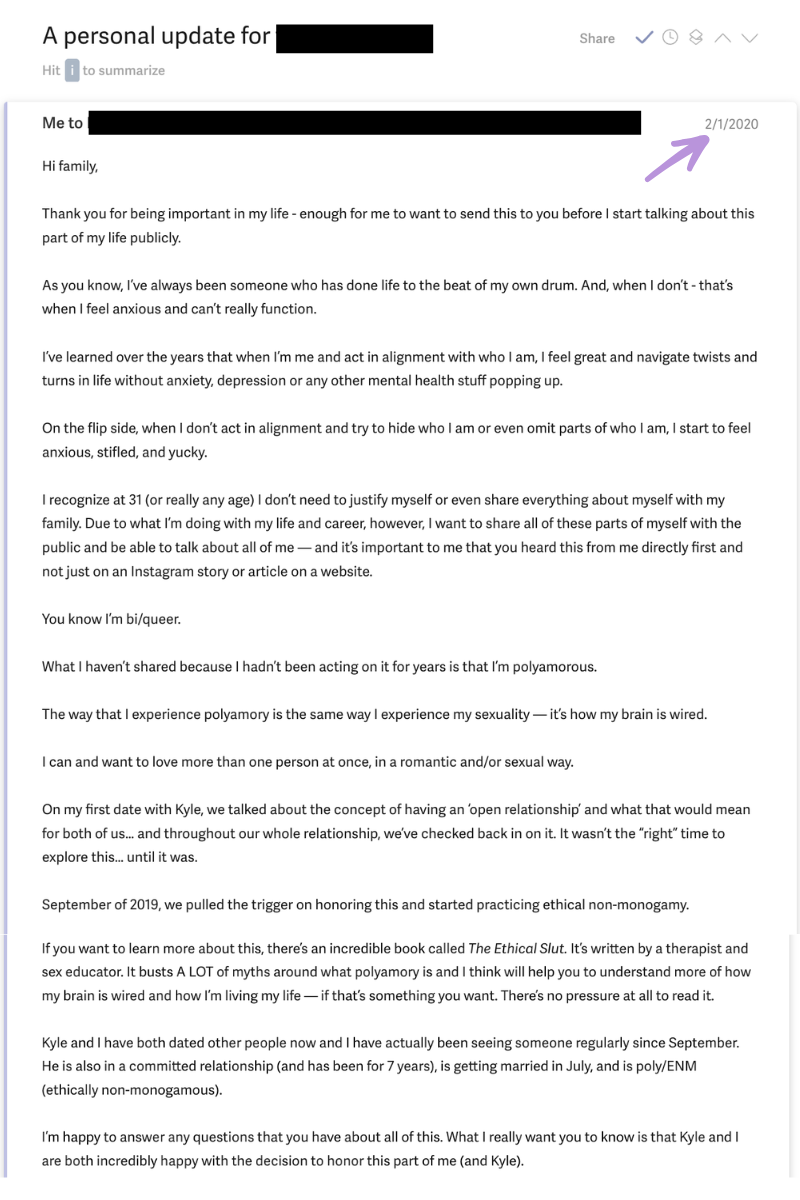
Not every family member needs (or deserves) a sit-down conversation. For some people in your life, an email or a letter is the better move — it gives them space to process without putting you in the position of managing their reaction in real time, and it lets you say exactly what you want to say without being interrupted or derailed.
Here’s the email I sent to family members I didn’t want or need to have a phone call or face-to-face conversation with. I wanted them to know, but I also wanted to be in the driver’s seat of how the information was delivered and give them space to sit with it before responding. Please note, I sent this in February 2020 and if I wrote this now, I’d probably use different language in some spots or recommend different resources, but I wanted to share with you exactly what I sent out.
Prepare for the long game
Coming out to family is rarely a one-conversation thing. The first conversation opens the door, and the ones that follow, over months and sometimes years, are where real understanding builds. Don’t expect full acceptance on day one, and don’t interpret initial discomfort as permanent rejection.
What to Do When It Doesn’t Go Well
Sometimes people react badly, say hurtful things, go silent, or convey disappointment in ways that sting. Here’s how to take care of yourself when that happens.
Let yourself feel it. A bad reaction from someone you love hurts, and there’s no shortcut around that. Give yourself permission to grieve the response you wanted but didn’t get.
Set boundaries around the conversation. If someone is being disrespectful, you’re allowed to say, “I want to keep talking about this, but I need the conversation to be respectful. Can we try again another time?” You don’t have to absorb someone’s fear or anger just because they’re family.
Don’t try to convince anyone in the heat of the moment. If someone is upset, they’re not in a learning state of mind. Let the dust settle. Follow up later if and when they seem more open.
Lean on your community. This is where having non-monogamous friends, a therapist who gets it, or an online community makes a real difference. You need people around you who understand what you’re going through and don’t require you to justify your existence.
Remember that their reaction is about them.
This is often hard to internalize, but it’s true. When someone reacts with fear or judgment, it’s usually about their own discomfort, their own values being challenged, their own anxiety about what this means for their understanding of you. That doesn’t make it hurt less, but it can help you take it less personally over time.
I can’t tell you the number of times I’ve told someone I’m non-monogamous/polyamorous, and their immediate response is, “Wow, I could never do that.” As though I were asking them about their capacity, orientation, or preferences.
While I’m so grateful that my conversations with my family and close friends went largely well, because I’m so public-facing, I’ve had a lot of things projected onto me by strangers on the internet. It certainly doesn’t hurt the way it would from someone close in my life, but it’s hard to receive, regardless. The more comfortable and confident I felt in who I was, who I am, the easier it is to let those things roll off my back, like a waxed duck.
What to Do When It Goes Better Than Expected
Sometimes the conversation goes surprisingly well, and that can be its own kind of disorienting. You’ve been bracing for the worst, and then your mom says, “OK, tell me about them.”
Let yourself enjoy it. You don’t need to start worrying about the next hard conversation right away. If someone received this well, take that in.
Follow their lead on how much they want to know. Some people will want to meet your partners right away. Others will need time to sit with the information. Both are fine.
Don’t over-explain or justify. If someone accepts you, you don’t need to keep making the case. Sometimes the urge to explain comes from so much time spent preparing for pushback. Notice it, and let yourself relax into the acceptance.
I was shocked at how accepting and validating my family was when I came out as polyamorous/non-monogamous. If memory serves me correctly, both my mom and grandma had some sort of “yeah, that makes a lot of sense for you” type of comment. They also had a ton of questions, but that validating reflection was so powerful and something I did not expect.
You Don’t Owe Everyone This Conversation
This is worth saying directly: you don’t have to come out as polyamorous to everyone in your life. Not to your parents, not to your coworkers, not to your extended family, and not to anyone who doesn’t directly need to know.
The Tarantino study found that many non-monogamous individuals deliberately and thoughtfully chose not to disclose to certain people, and that’s a valid option. Choosing privacy isn’t the same as being closeted. You get to decide who has access to this part of your life, and that decision can change over time.
The people who need to know are the people whose lives are directly affected — your partners, and in some cases, your kids. Beyond that, it’s your call.
FAQs
When is the “right time” to come out as non-monogamous? There’s no universal right time. It depends on your circumstances, your safety, and your readiness. Some people come out early in their non-monogamy journey; others wait years. Both are fine.
Should I come out to my kids? If your children are going to meet or interact with your partners, some level of honesty is usually better than secrecy. How much you share depends on their age and developmental stage. This is a big enough topic that it deserves its own conversation (and its own blog post — stay tuned).
What if my partner is out but I’m not? This is a common source of tension in non-monogamous relationships. It’s worth talking through with your partner(s) and, if needed, a therapist. There’s no rule that says you have to be out on the same timeline, but dealing with the difference requires dialogue and shared respect.
What if I come out and then my relationship structure changes? People’s relationship structures evolve. If you come out as polyamorous and later shift to monogamy (or vice versa), that’s not a failure or a contradiction, it’s just life. You don’t owe anyone a permanent commitment to a label or way of living.
How do I handle people who think non-monogamy is just cheating? Briefly and without showing defensiveness, if possible. Something like, “I understand why it might look that way if you’re not familiar with it. The key difference is that everyone involved knows and consents.” I recommend defining cheating and focus on the dishonesty aspect. With non-monogamy, it’s honest. Within the context of non-monogamy/polyamory, I personally view cheating as the breaking of an agreement. If they’re genuinely curious, they’ll ask more. If they’re not, no amount of explaining will change their mind right then.
TLDR
Coming out as polyamorous or non-monogamous to friends and family is a personal decision with no single right approach. The research shows that disclosure comes with real risks — stigma toward non-monogamous relationships is well known — but concealment has its own costs, including stress, mental health distress, fragmentation, and hiding the people you love.
If you decide to tell people, get clear on your why, start with the safest relationships, lead with your own experience rather than definitions, and prepare for the long game. If you decide not to tell certain people, that’s equally valid.
Your relationship structure is yours. Who you share it with and when are up to you.
References:
- Moors, A. C., Matsick, J. L., & Schechinger, H. A. (2017). Unique and shared relationship benefits of consensually non-monogamous and monogamous relationships: A review and insights for moving forward. European Psychologist, 22(1), 55-71.
- Tarantino, N. (2025). “Mom, I’m polyamorous”: Parental reactions to polyamory identity disclosures. Journal of Marriage and Family.
- “Monogamy? In this economy?”: Stigma and resilience in consensual non-monogamous relationships. (2023). Sexuality & Culture, 27, 1321-1345.
Related support
Explore Polyamory & ENM Therapy or Relationship Therapy, then use the inquiry form to find the right therapist or coach for your needs.
Want help applying this to your real life?
If this brought something up for you, you do not have to sort through it alone. Explore therapy, coaching, workshops, and learning options built around direct, inclusive, shame-free support.